

Change in Licence Policy for CAAS Journals
We would like to inform you that the journals published by the Czech Academy of Agricultural Sciences (CAAS) will change their licence policy. All articles submitted to CAAS journals from 2026 will be published under the Creative Commons Attribution 4.0 International Licence (CC BY 4.0).
The Creative Commons Attribution 4.0 International Licence (CC BY 4.0) allows broad reuse, distribution, and adaptation of published articles, provided that appropriate credit to the original authors is given.
Articles submitted by 2025 are distributed under the Creative Commons Attribution-NonCommercial 4.0 International (CC-BY-NC 4.0) license.
Impact factor (WoS):
2025: 1.3
Q3 – Veterinary Sciences
5-Year Impact Factor: 1.0
SCImago Journal Rank (SCOPUS):

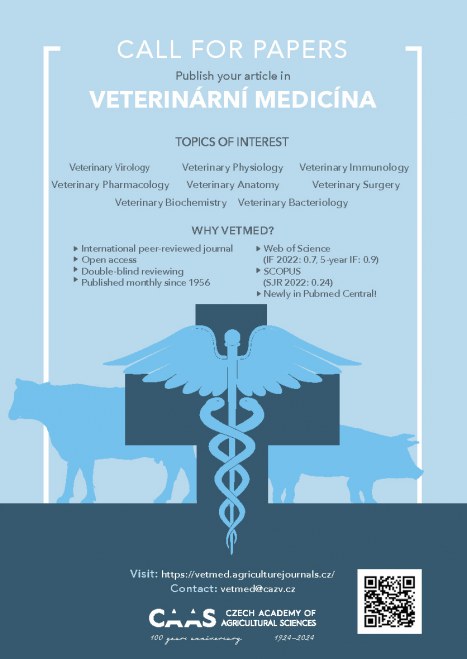
Veterinární medicína – veterinary medicine journal
- ISSN 0375-8427 (Print)
- ISSN 1805-9392 (On-line)
An international open access peer-reviewed journal published by the Czech Academy of Agricultural Sciences and financed by the Ministry of Agriculture of the Czech Republic
- The journal is administered by an international Editorial Board
- Published since 1956
- Editor-in-Chief: prof. MVDr. Miroslav Toman CSc.
- Co-Editors: prof. MVDr. Eva Baranyiová, CSc.; doc. Mgr. MVDr. Leoš Landa, Ph.D.; doc. MVDr. Pavel Suchý, Ph.D.; doc. MVDr. Michal Vlašín, Ph.D. ECVS, MRCVS; prof. MVDr. Dagmar Zendulková, CSc.
- Executive Editor: Bc. Adéla Zvěřinová, MSc.
- Technical Editor: Ing. Helena Smolová, Ph.D.
- The journal is published monthly
Aims & Scope
The journal Veterinarni Medicina publishes original papers, short communications, critical reviews and case reports from all fields of veterinary and biomedical sciences.
Current issue
The impact of 5% flaxseed supplementation on sex hormones, antioxidant status, and blood profile in female spotted deer during the breeding seasonOriginal Paper
Y Mesfer Alharbi, A Ibraheem Alnuqaydan, AKA Zaki
Vet Med - Czech, 2026, 71(10):399-414 | DOI: 10.17221/78/2025-VETMED 
Phytoestrogens, such as those found in flaxseed, can mimic oestrogen and influence animal physiology. For spotted deer, an economically significant species in Saudi Arabia, information on how phytoestrogen-rich diets affect reproductive health and overall physiology is limited, particularly in captive zoo settings. This work aimed to clarify the effects of a 5% flaxseed dietary supplement on the sex hormone profile, antioxidant capacity, haematological parameters, and histological features of female spotted deer during the onset of the breeding season. Twelve female deer were separated into two groups: a control group fed a standard diet of alfalfa...
Impact of preanalytical sample handling on GLP-1 measurement in porcine plasma: A pilot ELISA-based studyOriginal Paper
L Culka, J Novotny, L Leskova, Z Krepelkova, V Karaffova, M Madarova, P Schusterova
Vet Med - Czech, 2026, 71(10):415-421 | DOI: 10.17221/34/2026-VETMED
Glucagon-like peptide-1 (GLP-1) is an incretin hormone that plays a key role in the regulation of glucose metabolism; however, it is highly sensitive to biological sample handling conditions. The aim of this pilot study, conducted in two piglets and two adult finishing pigs, was to compare the effects of selected preanalytical factors on measured GLP-1 concentrations in porcine plasma and to identify conditions suitable for its reliable determination using ELISA. The evaluated factors included blood collection tube type (EDTA vs EDTA with a DPP-4 inhibitor), centrifugation temperature (4 °C vs room temperature), and sample processing conditions (fresh...
Salmonella enterica isolates from poultry in North-Central Nigeria reveal multidrug-resistant patterns and risk of contamination to the human food chainOriginal Paper
AO Sanni, AH Jibril, A Jonker, FO Fasina
Vet Med - Czech, 2026, 71(10):422-433 | DOI: 10.17221/76/2025-VETMED
Non-typhoidal (NT) salmonellosis is a major poultry-associated bacterial zoonosis. We undertook environmental sampling (poultry faeces and dust, n = 600) to evaluate the prevalence of NT Salmonella in poultry farms in North-Central Nigeria (NCN). Samples from five NCN states and Abuja were processed using standard bacterial culture and the invA-based PCR method, and isolates were tested against the 11 most used poultry antimicrobials by means of the Kirby–Bauer disk diffusion method. We measured inhibition zones using WHONET to classify resistance patterns. The overall prevalence rate was 18.7%, and prevalence rates in dust...
Heartworm removal using the basket catheter technique in a 1.85 kg cat with pulmonary hypertension and right-sided heart failure: A case reportCase Report
S-Y Park, W-K Yoon, Y Oh
Vet Med - Czech, 2026, 71(10):434-439 | DOI: 10.17221/91/2025-VETMED
Feline heartworm infection poses significant diagnostic and therapeutic challenges owing to its distinct clinical features compared to canine cases. Even a single worm can cause life-threatening complications, including pulmonary hypertension and right-sided heart failure. There is no definitive treatment available at present. A 5-month-old intact male domestic shorthair cat (1.85 kg) exhibited respiratory distress, pleural effusion and ascites. Clinical examination revealed a grade 4/6 systolic murmur, jugular vein distension and 7% dehydration. Despite negative antigen and antibody tests for heartworm, echocardiography revealed hyperechoic structures...